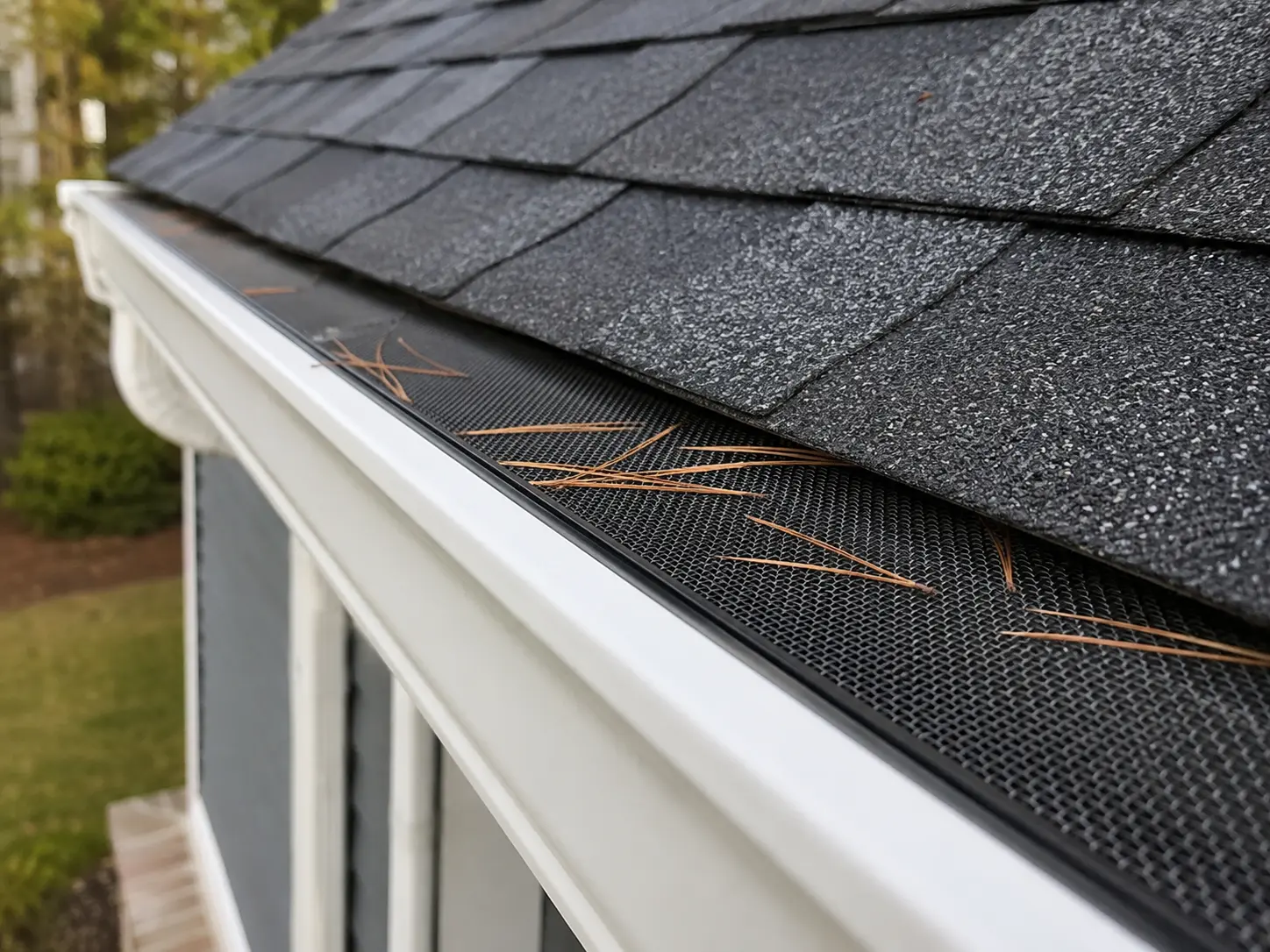
Homeowners asking whether gutter guards are worth it in Chapel Hill, NC are usually trying to solve a recurring problem: gutters fill again soon after cleaning, a roof valley sends debris into one short section, or access is difficult on a tall or sloped property. Those are reasonable reasons to compare protection, but the correct product depends on what actually reaches the roof edge.
Pine needles, broad oak leaves, pollen, twigs and roof granules do not behave the same way. A useful recommendation should also consider roof slope, valleys, gutter size, outlet placement and future access. Homeowners ready for an onsite evaluation can review CYM Contractors’ gutter guard installation service in Chapel Hill.
Why Chapel Hill tree cover changes the decision
Many Chapel Hill properties sit beneath mature mixed canopy. One elevation may receive narrow pine needles throughout the year while another receives a heavy seasonal drop of oak leaves. Shaded roof sections can hold damp organic material longer, and wooded or sloped lots can make repeated ladder access less practical.
The roof layout matters as much as the number of trees. Valleys collect water and debris from two roof planes and deliver both into a concentrated area. Dormers, additions and multi-level rooflines can create short gutter sections that carry more material than long open runs elsewhere on the same home.
If overflow is already occurring, identify whether the cause is debris, a blocked outlet, poor pitch, too little capacity or a damaged section. The guide to clogged gutters and mature trees in Chapel Hill explains the warning signs that should be checked before selecting a cover.
Pine needles and oak leaves create different problems
Pine needles are thin enough to enter larger openings. They can also lie across one another on top of a guard, particularly below a valley or over a damp, shaded section. Fine pollen and roof grit may settle with them and form a layer that slows water across the surface.
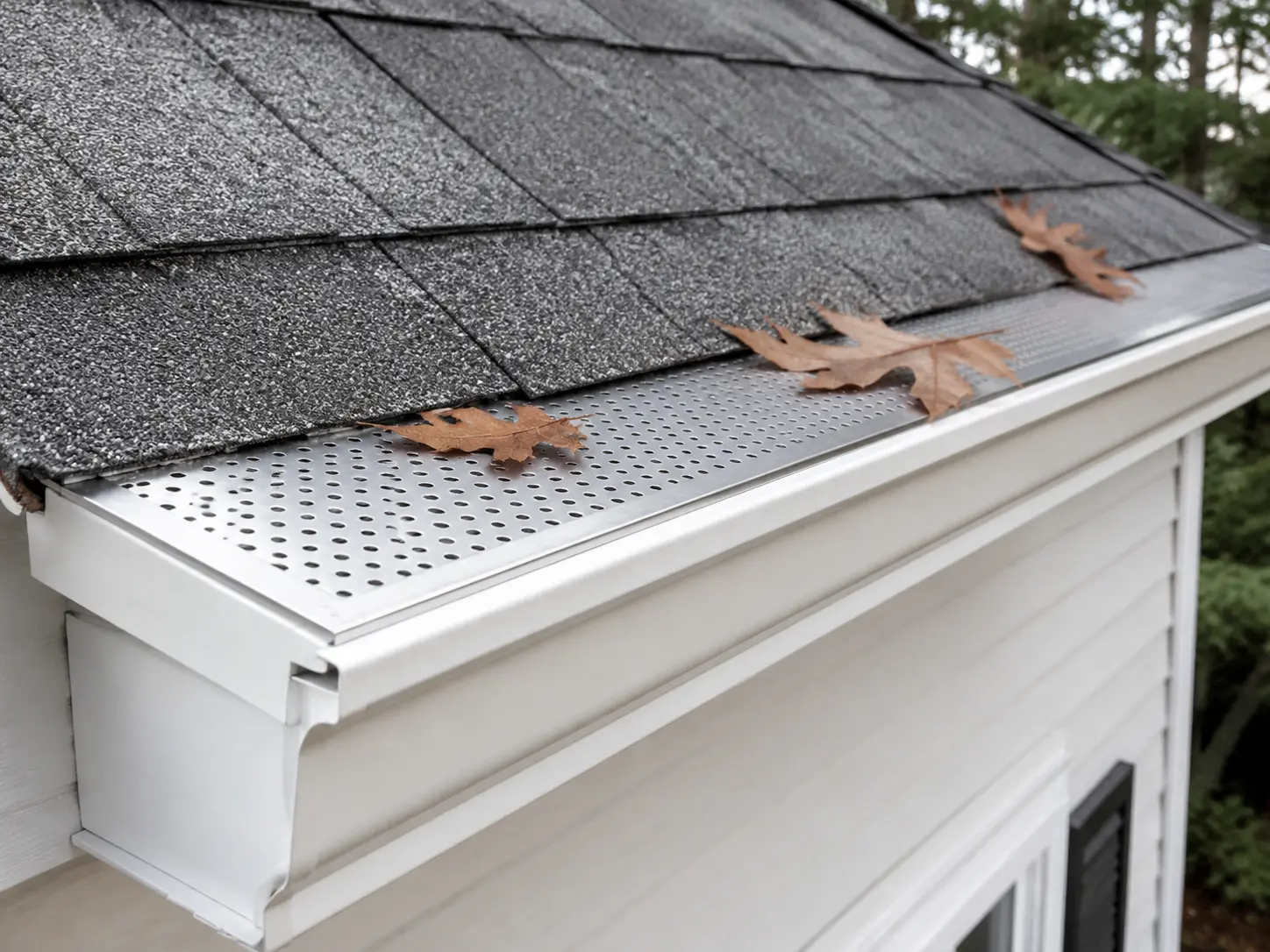
Oak leaves are larger and are usually easier for a guard to keep out of the trough. The challenge is volume: a heavy leaf drop can temporarily cover a long section. Wind and rain may move dry leaves away, but wet leaves can remain on a low-slope surface until they dry or are removed.
A mixed canopy therefore requires more than a product labeled for “leaves.” The installer should identify the smallest recurring debris, where material accumulates and how rain reaches that section.
Micro-mesh vs. perforated aluminum
CYM compares two practical categories rather than promising that one product fits every Chapel Hill roof. Fine micro-mesh is generally the first option to evaluate where pine needles and small debris dominate. Perforated aluminum can be a durable, low-profile option where broad leaves and larger material are the main concern.
| Condition | Micro-mesh | Perforated aluminum |
|---|---|---|
| Pine needles | Fine openings usually provide stronger exclusion | Performance depends heavily on hole size |
| Oak leaves | Keeps broad leaves out; surface checks still needed | Often a practical fit for larger leaves |
| Pollen and fine debris | Blocks more fine material but can develop surface buildup | Some fine material may pass through openings |
| Concentrated valley flow | Must be sized and fitted for the water volume | Open area must match the runoff demand |
| Maintenance | Periodic surface inspection and cleaning | Surface and below-guard inspection as needed |
The table is a starting point, not a product guarantee. Roof pitch, guard angle, gutter profile and installation detail all affect performance. A system that works well on an open front eave may require a different approach beneath a rear roof valley.
When gutter guards are likely worth considering
- The gutters repeatedly collect pine needles or leaves between normal cleaning visits.
- Several roof sections are difficult or unsafe for a homeowner to access.
- The gutters, outlets and downspouts are already in serviceable condition.
- The property has a clear plan for periodic surface inspection.
- The selected product matches the smallest common debris around the home.
The value is usually reduced debris inside the trough and more manageable maintenance—not the permanent elimination of cleaning. Guards can also keep larger material from bridging across outlets, provided the surface above the outlet remains open.
When cleaning or repair should come first
A guard should not be installed over packed debris, standing water or a loose gutter. Covering those conditions makes future diagnosis harder and does not correct the drainage problem. The existing system should be cleaned so the trough, joints and outlets can be seen before installation.
If water remains after cleaning, the run may have a low spot or inadequate pitch. Leaking corners, separated joints, loose hangers and weak fascia also need attention first. Chapel Hill homeowners can compare gutter cleaning and gutter repair before paying to cover a system that is not ready.

Roof valleys, gutter size and heavy rain
A roof valley can place the highest water and debris load on a very short section. The guard must admit that runoff without sending it across the front edge, while the gutter and nearby outlet must carry the water away. Adding a splash accessory without reviewing the entire flow path can simply move the overflow to another location.
Gutter capacity also matters. Five-inch gutters can work well on many roof sections, while larger or more concentrated areas may justify evaluating a 6-inch system and 3×4 downspouts. The Chapel Hill 5-inch vs. 6-inch gutter guide explains how roof area, run length, valleys and outlets affect that decision.
What maintenance remains after installation
No guard makes a roof edge maintenance-free. Pine needles can rest on micro-mesh, wet leaves can cover either product, and pollen can coat a fine screen. The practical goal is to keep most material out of the trough and make maintenance less frequent and easier to manage.
Inspect the visible surface after the principal leaf drop, major storms and periods when pine needles accumulate heavily. Pay special attention below valleys, at inside corners and near outlets. Watch the system during rain from the ground: water should enter the gutter rather than spill across the face, and the downspout should discharge consistently.
Maintenance frequency should be based on observed conditions. One side of a Chapel Hill home may need attention more often than another because of wind, shade, roof geometry or tree proximity.
What a useful gutter guard estimate should explain
- Which guard type is proposed and why it matches the property’s debris.
- Whether cleaning and outlet clearing are included before installation.
- The visible condition, pitch and attachment of the existing gutters.
- How roof valleys and other high-flow sections will be handled.
- Whether gutter size, outlets or downspouts need correction first.
- What periodic maintenance remains after installation.
- Which workmanship and product terms are included in the written scope.
If an estimate says only “gutter guards” without identifying the product, preparation and maintenance expectations, it is difficult to compare with another proposal. Homeowners who want a deeper product comparison can also read micro-mesh vs. perforated gutter guards.
The practical decision for a Chapel Hill home
Gutter guards are most likely to be worth the investment when they solve a documented debris problem on a functioning system. For pine-heavy properties, micro-mesh is often the stronger first comparison. Where broad oak leaves dominate, perforated aluminum may also be practical. Mixed-canopy homes need the product, roof flow and maintenance plan considered together.
Start with the existing gutters. Clean and repair them if needed, verify that water reaches open outlets, and then choose protection for the actual debris. That sequence avoids paying for a guard that hides a more important drainage problem.
Frequently asked questions
Are gutter guards worth it for pine needles in Chapel Hill?
They can be worthwhile when needles repeatedly reach the gutter and the base system drains correctly. Fine micro-mesh is usually the first type to compare, but its surface still needs periodic attention.
Which gutter guard is better for oak leaves?
Both micro-mesh and properly sized perforated aluminum can manage broad leaves. The presence of pine needles, pollen, fine debris and concentrated roof flow should guide the final choice.
Do gutter guards eliminate gutter cleaning?
No. They reduce debris inside the gutter, but leaves, pine needles and pollen can collect on the surface. Valleys, corners and outlets still require inspection.
Can guards be installed on existing gutters?
Yes, when those gutters are secure, correctly pitched and draining. Cleaning and repairs should be completed before the system is covered.
Should a guard be installed below a roof valley?
It can be, but the installer should evaluate concentrated runoff, gutter capacity, debris buildup and outlet placement instead of treating the guard as the only solution.
Compare gutter guards for your Chapel Hill home
CYM Contractors can inspect the existing system, identify the debris around each roof edge and explain whether micro-mesh, perforated aluminum, cleaning or repair is the practical next step.
Request a Free Estimate or call (919) 308-0106.